Analysis of 10x Visium human breast cancer slice#
In this tutorial, we demonstrate SpaSRL on the analysis of 10x Visium human breast cancer (block A section 1) slice including
Spatial expression enhancement
Self-representation learning
Spatial domain identification
Spatial domain annotation
Finding differentially expressed genes
The dataset is available at 10x genomics website (Spatial Gene Expression >> Visium Demonstration (v1 Chemistry) >> Space Ranger 1.0.0 >> Human Breast Cancer (Block A Section 1)).
[1]:
import numpy as np
import pandas as pd
import scanpy as sc
import matplotlib.pyplot as plt
import SpaSRL

%matplotlib inline
Data loading and preprocessing#
We load the dataset and find top 2000 highly variable genes.
[2]:
adata = sc.read_visium('./data/Human Breast Cancer (Block A Section 1)/')
adata.var_names_make_unique()
adata
Variable names are not unique. To make them unique, call `.var_names_make_unique`.
Variable names are not unique. To make them unique, call `.var_names_make_unique`.
[2]:
AnnData object with n_obs × n_vars = 3813 × 33538
    obs: 'in_tissue', 'array_row', 'array_col'
    var: 'gene_ids', 'feature_types', 'genome'
    uns: 'spatial'
    obsm: 'spatial'
[3]:
sc.pp.highly_variable_genes(adata, n_top_genes=2000, flavor='seurat_v3')
Spatial expression enhancement#
We perform spatial expression enhancement to aggregate expression from spatial neighbors.
[4]:
SpaSRL.spatial_enhancement(adata)
Self-representation learning#
We perform self-representation learning on the enhanced data.
[5]:
SpaSRL.run_SRL(adata, n_neighbors=30, n_pcs=15)
21%|██████▏ | 104/500 [00:09<00:37, 10.62it/s, relChg: 3.851e-05, recErr: 9.747e-06, converged!]
Spatial domain identification#
We identify spatial domians using the representation matrix.
[6]:
sc.tl.leiden(adata, resolution=0.65, neighbors_key='representation')
SpaSRL.refine_spatial_domains(adata, domain_key='leiden')
[7]:
fig, axs = plt.subplots(figsize=(8, 8))

sc.pl.spatial(
    adata,
    img_key='hires',
    color='leiden_refined',
    size=1.5,
    palette=sc.pl.palettes.default_102,
    legend_loc='right margin',
    show=False,
    ax=axs,
)

plt.tight_layout()
C:\ProgramData\Anaconda3\lib\site-packages\anndata\_core\anndata.py:1220: FutureWarning: The `inplace` parameter in pandas.Categorical.reorder_categories is deprecated and will be removed in a future version. Reordering categories will always return a new Categorical object.
  c.reorder_categories(natsorted(c.categories), inplace=True)
... storing 'feature_types' as categorical
C:\ProgramData\Anaconda3\lib\site-packages\anndata\_core\anndata.py:1220: FutureWarning: The `inplace` parameter in pandas.Categorical.reorder_categories is deprecated and will be removed in a future version. Reordering categories will always return a new Categorical object.
  c.reorder_categories(natsorted(c.categories), inplace=True)
... storing 'genome' as categorical

Spatial domain annotation#
We annotate the spatial domains based on the pathologist annotation from Fu, H. et al.
[8]:
map_dict = {
    '0': 'Surrounding tumor',
    '1': 'Invasive',
    '2': 'Invasive',
    '3': 'Healthy',
    '4': 'Invasive',
    '5': 'Tumor',
    '6': 'Tumor',
    '7': 'Tumor',
    '8': 'Invasive',
    '9': 'Surrounding tumor',
}
[9]:
adata.obs['annotation'] = pd.Categorical(
    adata.obs['leiden_refined'].map(map_dict),
    categories=['Invasive', 'Tumor', 'Surrounding tumor', 'Healthy']
)
[10]:
fig, axs = plt.subplots(figsize=(8, 8))

sc.pl.spatial(
    adata,
    img_key='hires',
    color='annotation',
    size=1.5,
    palette=sc.pl.palettes.default_102,
    legend_loc='right margin',
    show=False,
    ax=axs,
)

plt.tight_layout()

Finding differentially expressed genes#
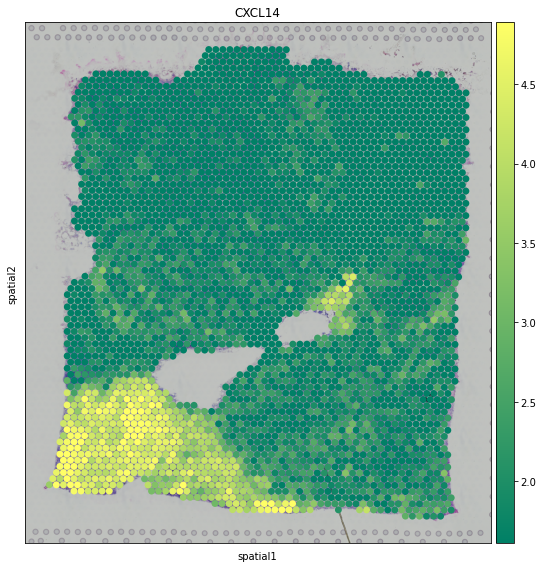
We find the differentially expressed (DE) genes across identified domains and show their expression patterns in spatial coordinates.
[11]:
sc.tl.rank_genes_groups(adata, groupby='leiden_refined', use_raw=False, layer='counts', method='t-test')
[12]:
DE_genes = pd.DataFrame(adata.uns['rank_genes_groups']['names']).iloc[:10,:]
DE_genes
[12]:
| 0 | 1 | 2 | 3 | 4 | 5 | 6 | 7 | 8 | 9 | |
|---|---|---|---|---|---|---|---|---|---|---|
| 0 | IGLC2 | CXCL14 | COX6C | ACKR1 | CRISP3 | CPB1 | MGP | S100G | LINC00645 | ALB |
| 1 | IGHG1 | CCND1 | SLC39A6 | CCL21 | SLITRK6 | HLA-B | S100G | HLA-B | MUC5B | MGP |
| 2 | IGLC3 | DEGS1 | SNCG | CLDN5 | S100A13 | IL6ST | DSP | HLA-A | IGFBP2 | PGC |
| 3 | IGKC | CPNE7 | WFDC2 | CHRDL1 | SERHL2 | ADIRF | TFF3 | AC087379.2 | PVALB | MT-ATP8 |
| 4 | C3 | DEGS2 | MT-ND1 | MMRN1 | IGFBP5 | HLA-C | MT-CO2 | IFI6 | ZNF703 | HBA2 |
| 5 | IGHG3 | PSMB4 | CSTA | ADAM33 | CALML5 | CFB | ACADSB | IFI27 | SLC39A6 | MT-ND2 |
| 6 | SFRP4 | MUC1 | MCCD1 | TNXB | S100A16 | HLA-A | MT-CO1 | IFT122 | EXOC2 | S100A7 |
| 7 | JCHAIN | S100A11 | MT-CO1 | TTN | KRT8 | COX6C | TFF1 | BST2 | COLEC12 | HBB |
| 8 | IGHM | GFRA1 | RAB11FIP1 | INMT | S100A11 | H2AFJ | IGFBP5 | ISG15 | SLC30A8 | CCL7 |
| 9 | IGHG2 | AGR2 | UGCG | CCL19 | NUPR1 | FCGRT | LDHA | LGALS3BP | PLXNB2 | STEAP4 |
[13]:
fig, axs = plt.subplots(figsize=(8, 8))

sc.pl.spatial(
    adata,
    img_key='hires',
    color=DE_genes.iloc[0,0],
    layer='log1p',
    size=1.5,
    cmap='summer',
    vmin='p50',
    vmax='p99',
    show=False,
    ax=axs,
)

plt.tight_layout()

[14]:
fig, axs = plt.subplots(figsize=(8, 8))

sc.pl.spatial(
    adata,
    img_key='hires',
    color=DE_genes.iloc[0,1],
    layer='log1p',
    size=1.5,
    cmap='summer',
    vmin='p50',
    vmax='p99',
    show=False,
    ax=axs,
)

plt.tight_layout()